


LE TIE&DYE : D’UNE TECHNIQUE ANCESTRALE À UNE TENDANCE
THE ORIGINS /
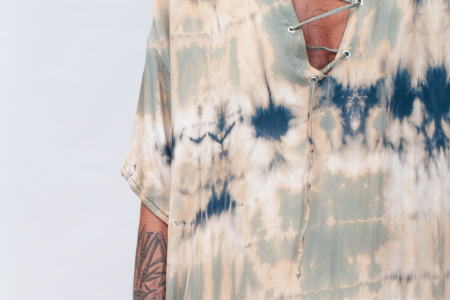
We need to take a leap back in time and travel to Asia to trace the origins of this method. This folding and dyeing technique first appeared in Japan in the 6th century under the name Shibori. At the time, indigo was the primary dye used, as this color could be produced in countless variations. Thus, depending on the fabric, artisans worked to create a true art of gradation by knotting, twisting, and folding the textiles. This ancient technique was revived at another point in history and became the symbol of a generation.

© Kinfolk
TIE-DYE IN THE 70'S /
Tie-dyeing came to the forefront in the 1970s, becoming a symbol of peace, freedom, and self-affirmation for young people at the time. It was worn on t-shirts in bright colors, often with a swirling pattern. It was seen at all kinds of music festivals, notably at the famous Woodstock festival on the chests of Janis Joplin and Joe Cocker, as well as at peace demonstrations.

JOE COCKER, WOODSTOCK 1969
FROM THE HIPPIE MOVEMENT TO HAUTE COUTURE /
The enthusiasm for the tie and dye had such an impact that it permeated the Haute couture . For several years now, these hazy and psychedelic shapes have graced the catwalks and red carpets, taking on a more elegant and sophisticated form. tie and dye is a constantly evolving cultural phenomenon, inspired by many influences, it remains a dynamic symbol, associated with an ideal and a form of creativity.

Christian Dior SS21 Fashion Show © ELLE
A DIY TECHNIQUE /
The tie-dye technique is very simple to do, as its name suggests: "to tie" means to knot and "to dye" means to dye. All you need is rubber bands, a bottle of pure bleach, a container, and the garment you want to customize. Remember to wear white to avoid damaging your clothes. Click to watch our video tutorial.